 Casefile
Lender-Ready Packages: What UK Brokers Should Submit
A lender-ready package is a mortgage case submitted with every document the lender needs for that client's income type, checked for consistency, so the underwriter has nothing to query. For a broker the goal is simple: one submission, no requests for more evidence. Getting there depends on three things: a document list matched to how each applicant is paid, a cross-check of the documents against each other and against the fact find, and a record of what has arrived. Casefile automates all three for UK brokerages.
TL;DR
- A lender-ready package is complete for the applicant's income type, legible, consistent with the fact find and held together as one submission.
- Document lists differ by employment status: employed, self-employed and multiple-income clients each need different evidence.
- Most queries come from missing pages, mismatched figures and commitments the client did not declare, all of which can be found before submission.
- Lenders such as Barclays hold documents until the broker confirms everything is uploaded, so tracking outstanding items decides when the case reaches an underwriter.
- Casefile builds each client's document list from their payment type, cross-checks the files and flags discrepancies before the case reaches the lender.
Table of Contents
- What lender-ready means in practice
- What lenders ask for, by income type
- Five checks before a case goes to the lender
- The discrepancies that trigger lender queries
- Tracking what is outstanding
- Why small brokerages feel this most
- Putting it into a routine
- Casefile for lender-ready cases
- Our view
- FAQ
- Sources
What lender-ready means in practice
No regulator defines the phrase. Brokers use it for a case that goes to the lender with nothing outstanding. In practice it has four parts:
- Completeness. Every document the lender asks for is present, with all pages.
- Validity. Documents are recent, legible and from a source the lender accepts.
- Consistency. Income, outgoings and commitments agree across payslips, bank statements, tax documents and the application itself.
- Traceability. The broker can show what was received, when, from whom and who approved it.
The fourth part is the one small brokerages tend to lose first. Documents arrive by email, WhatsApp and portals, and the status of a case lives in an adviser's head. A package built that way is slow to assemble and hard to defend if a lender or compliance reviewer asks how a figure was verified.
What lenders ask for, by income type
Requirements vary by lender, so the lender's own criteria always decide the final list. A useful reference point is the evidence guidance from Sesame, a UK mortgage network, which sets out different requirements by employment status in its know-your-customer guidance, effective 1 June 2024.
| Applicant type | Typical evidence in that guidance |
|---|---|
| Employed, paid monthly | Three consecutive months' payslips plus the most recent P60 |
| Employed, paid weekly | Five to six payslips (all of the latest month plus one from each of the previous two months) plus the most recent P60 |
| Self-employed | A tax year overview and tax calculation, or the last three years' accounts, or an accountant's letter with business bank statements |
| Multiple income sources | Evidence for every income stream the case relies on |
The same guidance sets conditions on the documents themselves. Handwritten payslips, or payslips that do not confirm the employer's name, need matching bank statements to show the money arrived. Online bank statements are acceptable only when they show the amount credited and the employer's name on salary, the secure web address they came from, the bank's name, the account number and holder name, a running balance, and no handwritten amendments.
That level of detail is why a generic checklist fails. A client paid weekly, with a second income from rental property and a joint applicant who is a director, needs a different list from a salaried single applicant. Casefile builds the document list from the client's payment type, so each applicant is asked for the right evidence from the start rather than being sent a standard list and chased for the gaps. It supports multiple applicant types, which matters on joint cases where each person has a different profile. Our guide to multi-applicant mortgage documents covers that in more detail.
Five checks before a case goes to the lender
Each check below is a step in building the package, with the point where it usually goes wrong.
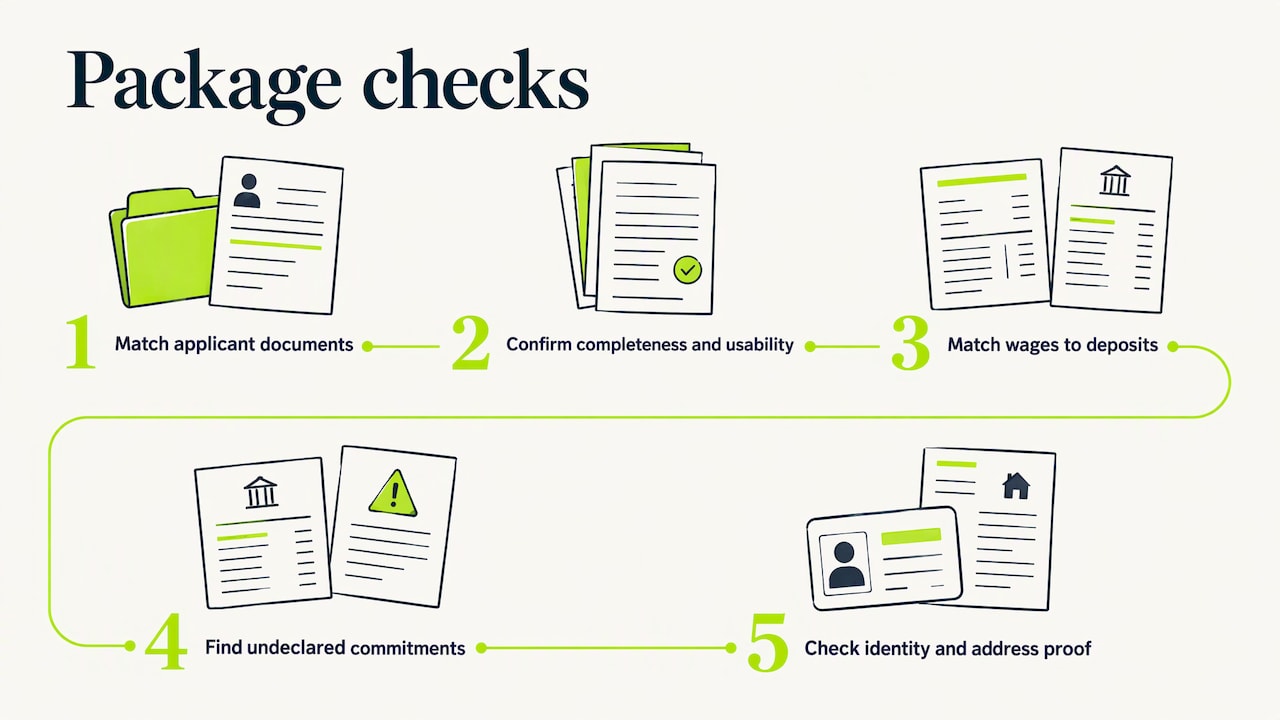
1. Match the document list to the applicant
Start from how each applicant is paid, not from a template. Where it goes wrong: the list is built at the first meeting, the client's circumstances turn out to be more complex (a bonus, a second job, a recent change of employer) and the extra evidence is only requested after the lender asks. Casefile's self-building lists respond to the payment type, so the request to the client already reflects it. For bonus and variable pay, the checks are set out in our guide to bonus income verification.
2. Confirm each document is whole and usable
Look for missing pages, cropped screenshots, expired or out-of-period statements, and statements that lack the identifying details a lender expects, such as those in the list above. Where it goes wrong: a photo of half a statement passes a quick glance and fails at underwriting. Casefile verifies document authenticity and detects tampering as part of its review, which takes this inspection off the adviser's desk. A broader view of document handling is in real estate document management, which looks at completeness and legibility from a workflow angle.
3. Match wages to deposits
The payslip says one figure, the bank statement shows another. Sometimes the cause is innocent, such as salary sacrifice or a timing difference, but an underwriter will ask either way. Where it goes wrong: the adviser reads the payslip, reads the statement and does not line them up line by line. Casefile matches wage deposits to the documents and highlights mismatches so the explanation can be gathered from the client before submission.
4. Look for commitments the client did not declare
Bank statements often show a loan repayment, a finance agreement or a regular payment to a card provider that is missing from the fact find. Where it goes wrong: the affordability assessment is built on an incomplete picture and the lender's own checks find the rest. Casefile flags undeclared commitments so that the fact find can be corrected first. Our article on how brokers catch document discrepancies early walks through the common patterns.
5. Check identity and proof of address
Identity and address documents are part of the package as much as income evidence. Where it goes wrong: names or addresses differ between documents, or a utility bill is out of date. Casefile cross-checks ID and utility bills with the rest of the file. For the identity side, see identity document verification for UK mortgage brokers and the mortgage fraud red flags checklist.
The discrepancies that trigger lender queries
Most avoidable queries fall into a short list:
- Payslips for the wrong period, or fewer than the lender asks for.
- Bank statements missing pages or showing only a summary.
- Salary credits that do not match the payslip.
- Income on the application that differs from the documents.
- Debts or regular payments visible on statements but absent from the application.
- Self-employed figures that do not agree across the tax overview, accounts and business bank statements.
None of these is exotic. Each is visible in the documents the broker already holds, which is why checking at the broker stage is cheaper than answering a query a week later. A query pauses the case, the client has to find a new document, and the adviser has to explain a discrepancy they could have raised on day one. Our guide on how to reduce lender queries on mortgage cases covers the wider routine, and the income verification guide for UK brokers sets out the income side in detail.
The Sesame guidance frames the underlying duty well: brokers should gather information from appropriate sources, make sure it is plausible and support it with evidence where necessary. A package that has been cross-checked is the practical form of that duty.
Tracking what is outstanding
Submission timing is often controlled by the last missing document. Barclays' mortgage FAQ for intermediaries (June 2026) describes the mechanism: if not all documents are available at submission, the broker uploads what they have and indicates that more are needed. The documents are then held, not sent to the underwriter until all are confirmed as uploaded, and are submitted together. After submission, further requests go through an amendment form or a new requirement raised by the lender.
The consequence is that a case with one missing document is, from the underwriter's side, a case that has not started. The broker needs to know at any point:
- which documents have been requested, received and approved for each applicant;
- which are waiting on the client and for how long;
- which have been flagged and why.
Casefile manages a document approval queue, so advisers see what needs review rather than opening every email attachment. Clients upload through a platform carrying the brokerage's own branding, with a clear request in plain language, which reduces the back-and-forth that normally fills an adviser's inbox. Documents are held with UK-only data residency, and the way the platform handles your documents is set out on our site. The audit trail records what was received and approved, which helps if a case is reviewed later.
How clients provide bank data is a separate decision, covered in Open Banking vs document upload.
Why small brokerages feel this most
A larger firm can have a dedicated case-support team that chases documents and checks them. A small brokerage usually has advisers doing it between client meetings. Every manual check is time taken from advice, and every missed discrepancy returns later as a query. Casefile is built for that setting: it removes repeated manual checks, keeps client communication straightforward and is designed to need minimal technical learning, so a small team can adopt it without a long training period.
Putting it into a routine
A workable routine for each case:
- Set up the applicants and let the platform generate each document list.
- Send the request to clients under the brokerage's branding.
- Review the approval queue and resolve flagged items with the client.
- Confirm the package is complete for every applicant.
- Submit once, with the supporting evidence and audit trail in order.
The order matters. Discrepancies are cheapest to resolve while the client is still engaged and before the lender has formed a view of the case.
Casefile for lender-ready cases
Casefile is a cloud platform for UK mortgage brokers that collects client documents, cross-checks bank statements, payslips, tax forms, ID and utility bills, and flags discrepancies and undeclared commitments before the lender sees them. It verifies document authenticity, detects tampering, matches wage deposits, supports multiple applicants and keeps data in the UK. Brokerages subscribe after onboarding and setup, and the platform carries their own branding. To see how it fits your case flow, visit Casefile.

Our view
Lender-ready is often treated as a final tidy-up before submission. We think it is a property of the whole process, and it begins when the document list is created.
The reason is simple. Every query that reaches a broker was visible in the documents earlier: the deposit that does not match the payslip, the repayment missing from the fact find, the statement with a page absent. Finding these by hand across several cases a week is slow, and it is the first task to slip when the diary fills.
That is why Casefile builds lists from each client's payment type, cross-checks the documents automatically and highlights issues before the lender can raise them. UK-only data residency and a clear audit trail mean the evidence behind each case is easy to account for. Brokerages keep their own branding on the client experience, and advisers spend their time on advice instead of inspection.
A lender-ready package should be the normal output of a good process, not a rescue.
Darren
FAQ
What does a lender-ready package include?
It includes the documents the lender requires for each applicant's income type, plus identity and address evidence, complete and legible, with figures that agree across all sources. For employed applicants paid monthly, one UK network's guidance asks for three consecutive months' payslips and the latest P60. Self-employed applicants need tax or accounts evidence instead.
Do all UK lenders ask for the same documents?
No. Requirements vary by lender and by applicant, and the lender's own criteria are the final word. That is why a document list generated from the client's payment type is more reliable than a single template.
What happens if a document is missing at submission?
With some lenders, the case waits. Barclays' intermediary FAQ explains that documents are held until the broker confirms all are uploaded, then submitted to the underwriter together. Tracking what is outstanding therefore determines when underwriting starts.
Which discrepancies cause the most queries?
Payslip and bank deposit mismatches, income that differs between application and documents, incomplete statements and commitments that were not declared. All can be spotted from the documents a broker already holds, which is why Casefile highlights them before submission.
Sources
- Know your customer: Home finance advice (Sesame, effective 1 June 2024)
- Barclays mortgage FAQ (June 2026)
- Real estate document management
Recommended
- Audit Readiness for UK Mortgage Brokers: 6 Steps
- Open Banking vs Document Upload: What UK Brokers Need
- Document Intake Forms for UK Mortgage Brokers: A Practical Guide
- Automated Document Collection for UK Mortgage Brokers
This article was generated with AI, and whilst it is our expectation that the article is accurate, it should not be taken as advice.