 Casefile
Contractor Income Verification for UK Mortgage Brokers

Contractor income verification means proving, with evidence independent of the client, that the income declared on a mortgage application is real, current and calculated the way the chosen lender calculates it. For contractors this is harder than for PAYE clients, because the evidence changes with the client's structure (limited company, sole trader, CIS, umbrella, fixed-term PAYE) and every lender applies its own multiplier, contract-length rule and document list. The brokers who avoid underwriter queries sort the client into the right category first, collect the right documents once, and cross-check them before submission. That cross-checking is the manual work Casefile automates.
TL;DR
- The FCA requires evidence of declared income that is independent of the customer and adequate for each element of income. Self-certification is not accepted.
- Lenders treat the same contractor differently. Day-rate multipliers of 46 weeks are common, but contract length, gap tolerance, shareholding and minimum rates vary.
- The document list depends on how the client is paid. Getting the category wrong at fact-find is the main cause of repeat document requests.
- Cross-check contracts, bank statements and tax records against each other before submission. A day rate that bank credits do not support will be caught by the lender.
- Casefile builds the document list from the client's payment type, collects the documents and flags mismatches and undeclared commitments before they reach a lender.
Table of Contents
- What the FCA requires you to evidence
- Step 1: Classify the contractor before you collect anything
- Step 2: Know how lenders turn a day rate into income
- Step 3: Collect the documents that match the structure
- Step 4: Cross-check before the lender does
- Step 5: Reduce the back-and-forth with clients
- How Casefile handles contractor documents
- Our view on contractor files
- FAQ
- Sources
What the FCA requires you to evidence
The regulatory baseline sits in the FCA Handbook. MCOB 11.6.8R says a firm must obtain evidence of the income the customer declares, either from documents or from automated systems. The evidence must be of a type and cover a period adequate to support each element of income taken into account. It must be subject to anti-fraud controls, and it must come from a source independent of the customer. The firm must not accept self-certification.
The FCA's MCOB 11 guidance also says the evidence needed varies with whether the customer is employed, self-employed, a contractor or retired, with length of employment, and with any non-guaranteed income. In practice that means a contractor file is never a payslip file with a different label. Each element of income (day rate, dividends, salary, CIS payments) needs its own support.
The rule gives you the principle. The lender's criteria give you the actual document list and the calculation, and those differ.
Step 1: Classify the contractor before you collect anything
Most avoidable queries start at fact-find. A client who says "I'm a contractor" may be any of the following, and lenders treat them differently:
- Limited company day-rate contractor, usually a director and shareholder, invoicing an end client or agency.
- Sole trader or CIS subcontractor, paid under the Construction Industry Scheme with deductions at source.
- Umbrella company worker, paid through payroll but often assessed differently from a standard PAYE employee.
- Fixed-term PAYE contractor, employed directly or via an agency on a defined term.
The classification decides which lender is realistic, which calculation applies and which documents you request. Ask three questions early: who pays the client, how are they paid (invoice, payslip, remittance), and who owns the company if there is one. Record the answers in the file so every later check refers back to them.
Casefile builds the document list automatically from the client's payment type, so the category set at the start drives what the client is asked to upload, rather than a generic checklist that then needs chasing.
Step 2: Know how lenders turn a day rate into income
The common method is day rate multiplied by five days and then by a number of working weeks, usually 46. The detail around that method is where lenders diverge. The table below uses figures from each lender's published intermediary criteria. Criteria change, so confirm against the live page before you submit.
| Lender (UK) | Day-rate method and key conditions |
|---|---|
| Skipton Building Society | Day rate × 5 × 46 weeks. Needs two years' experience in the same field, 12 months' contract history, a current contract and one month's bank statement. Gaps over four weeks in the last 12 months are pro-rated. Sole shareholder, or shares split with a spouse or partner on a joint application. |
| Barclays | Lower of the average daily rate across the two most recent contracts, the most recent daily rate, or actual bank-statement income, × 5 × 46. Limited company with no other employees, 100% owned by the applicants, at least £218 a day or £50,000 a year gross, LTV 90% or below. |
| NatWest | For contractors earning over £75,000, weekly contracted income × 46. Contracts covering 12 months with at least six months completed, and no break over six weeks. Significant business expenses are evidenced and deducted. |
| Aldermore | Latest contract's daily or weekly rate × 46 for self-employed, other day-rate and CIS contractors. Fixed-term contractors use the latest three months' average weekly income × 52. |
| Pepper Money | Lower of the 12-month average day rate × 5 × 46 or the current day rate × 5 × 46, for umbrella and limited company day-rate contractors with at least 12 months as a day-rate contractor. |
| The Tipton | Fixed-term and self-employed limited company contractors are assessed on the current day rate × 240 working days, with at least three months remaining. |
Three patterns matter for verification:
- Shareholding is a gate. Skipton limits the day-rate calculation to sole shareholders or spouse and partner splits, and moves a case with a third-party shareholder to the standard self-employed basis. Barclays requires the applicants to own 100%. Check the share register or accounts before you pick the lender.
- Contract remaining varies from one month to six. Aldermore asks for one month remaining on the current contract or an agreed renewal. Vida Home Loans asks for at least six months for limited company contractors. A contract ending in eight weeks suits one and fails the other.
- The lowest of several figures often wins. Where a lender takes the lower of the contract rate and the bank-statement income, the bank statements are not a formality. They set the income.
Step 3: Collect the documents that match the structure
Requirements are lender-specific, but the document types are consistent. Use the lender's own list as the final authority.
Limited company contractors
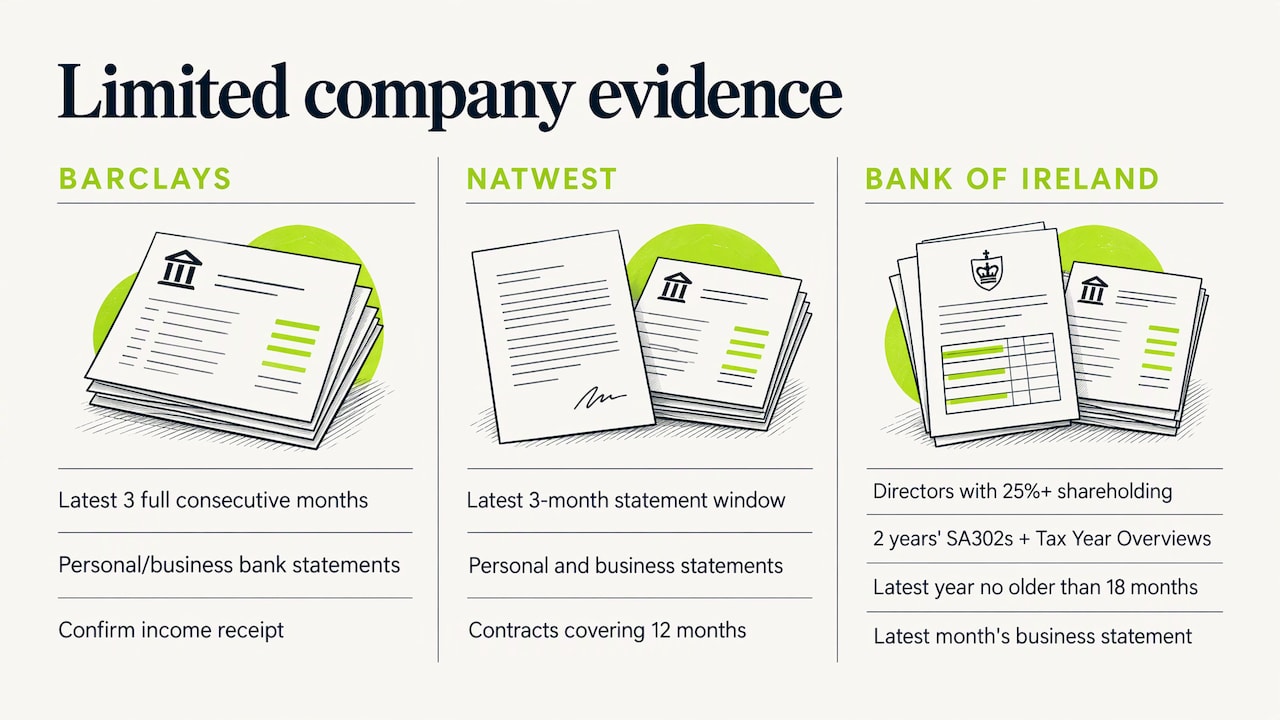
Expect the current contract (and prior contracts covering the required history), personal and business bank statements, and often SA302s with Tax Year Overviews or an accountant's certificate. Barclays asks for the latest three full months' consecutive personal and business bank statements confirming receipt of income. NatWest asks for the same three-month window plus contracts covering the 12-month period. For limited company directors with a 25% or greater shareholding, Bank of Ireland asks for the latest two years' SA302s with Tax Year Overviews, the latest year being no older than 18 months, plus the latest month's business bank statement. See our guide on the Tax Year Overview for mortgages for what to check on the document itself.
CIS and sole trader contractors
Skipton accepts a one-year summary of payments from the employer or accountant, the latest SA302, or 12 months of invoices or payslips, each with the latest full month's bank statement. It does not accept weekly remittance slips. Santander's November 2026 evidence guide takes CIS Payment and Deduction statements with Tax Year Overviews for the latest two years, and the latest CIS statement must be no more than six months old. Those statements must show the contractor and employer details, UTR, gross payment, materials cost and deduction amount. A statement missing the UTR or the materials line is a query waiting to happen. For tax documents more generally, see our tax return verification guide.
Umbrella company workers
The umbrella arrangement is the easiest to misclassify. Santander's November 2025 guide treats umbrella clients as self-employed, needing two years' SA302s or Tax Year Overviews, the end-client contract terms and evidence of future contracts. Vida assesses umbrella contractors on the last three months' payslips and the most recent P60, in line with PAYE applicants. Aldermore uses gross income from the umbrella once expenses such as commission and employer pension are removed. The same client can therefore need very different packs depending on the lender. Payslip-level checks are covered in our payslip verification guide.
Fixed-term PAYE contractors
Nationwide requires fixed-term contractors to have 12 months in post or at least 24 months remaining on the current contract, with a fully signed contract and an extension letter if it was extended. Bank of Ireland asks employed contractors for the current contract and all contracts held in the past 12 months.
Step 4: Cross-check before the lender does
A complete pack is not a verified pack. Underwriters compare the documents against each other, and a broker should do the same first. Five checks catch most problems on a contractor file.
- Contract rate against bank credits. Convert the contract rate into the expected monthly receipts and compare them with the credits on the statements. Where the lender uses the lower of contract rate and bank-statement income, as Barclays does, a shortfall here lowers the borrowing figure.
- Gaps between contracts. Lenders set limits: Skipton pro-rates gaps over four weeks, NatWest and Barclays allow no break over six weeks. Plot the contract dates on a timeline and count the gap in weeks.
- Contract end dates against the lender's remaining-term rule. Compare the end date with the lender's minimum, and look for the next contract or a renewal letter.
- Tax records against the declared figure. SA302 net profit, Tax Year Overview and accounts should agree with what the client told you. Differences between a limited company's dividends and drawings and the stated income are common.
- Commitments on the statements against the fact-find. Direct debits for loans, car finance, childcare or credit agreements that the client did not declare affect affordability. Our bank statement checks guide lists what to look for, and the authenticity guide covers signs of altered statements.
NatWest also expects significant business expenses such as car finance, travel, training, professional indemnity insurance and partner or employee salaries to be evidenced and deducted. Business statements are where those show up.
Worked example
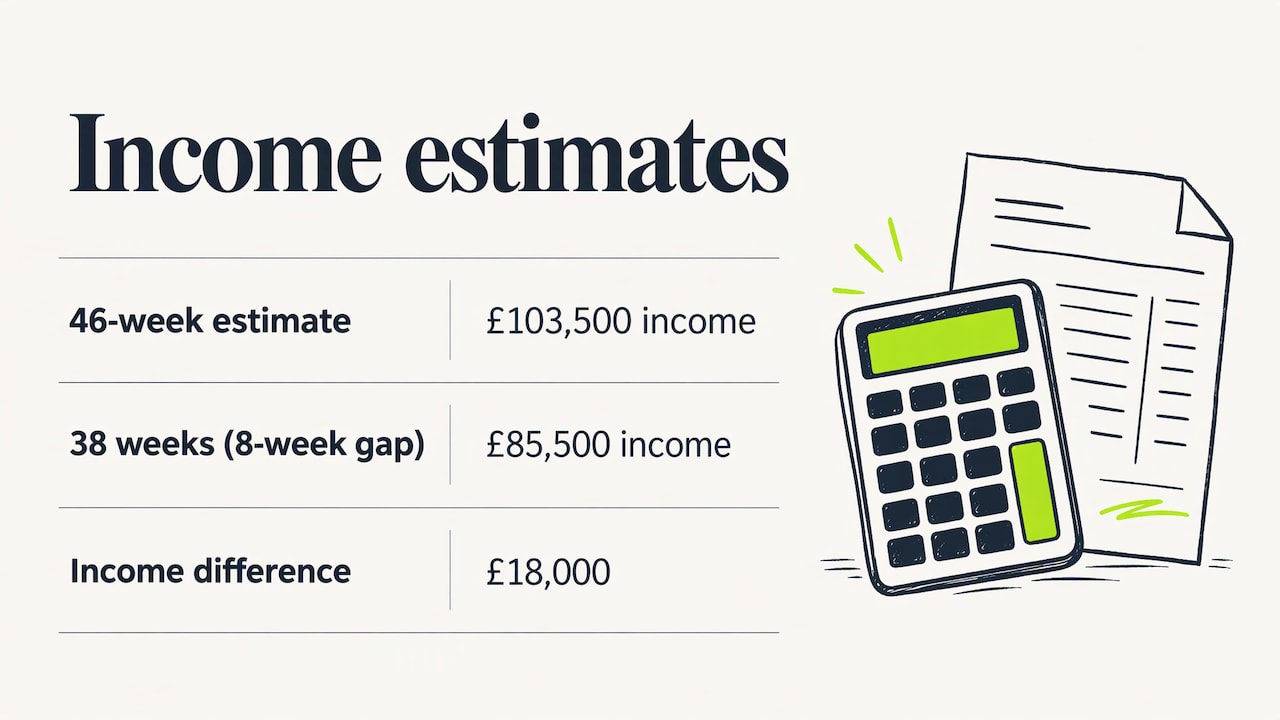
A client tells you they earn £450 a day through their own limited company, as sole shareholder. The lender uses day rate × 5 × 46, so the headline figure is £450 × 5 × 46 = £103,500. The contract confirms £450 a day. The bank statements, though, show business receipts consistent with only 38 weeks of invoicing in the last year because of an eight-week gap. Under Skipton's method, an eight-week gap uses × 38 weeks instead, giving £450 × 5 × 38 = £85,500. The difference is £18,000 of income. Finding it at pack stage means you can set the right expectations and pick the right lender. Finding it at underwriting means a re-assessment and delay.
Step 5: Reduce the back-and-forth with clients
The delay on contractor cases is rarely the checking itself. It is the cycle of asking, receiving the wrong document, asking again and re-reading. Three habits shorten it:
- Ask once, with a precise list. Tell the client exactly which documents, for which period, and in which format (full statements, not screenshots of transactions).
- Specify the period. Lenders count back from the application date, and age limits apply. Santander's CIS statements must be no more than six months old, and its business bank statement must be dated within 30 days.
- Review on arrival. A queue that is reviewed as documents come in lets you correct a wrong upload while the client still has the request in mind.
For the wider picture of how these checks fit together on any income type, see our income verification guide for UK brokers.
How Casefile handles contractor documents
Casefile is a cloud-based platform for UK mortgage brokers that automates document collection and review. For contractor cases it builds the document list from the client's payment type, collects bank statements, payslips, tax forms, ID and utility bills, and cross-checks them against each other. It flags discrepancies and undeclared financial commitments, matches wage deposits, verifies document authenticity and detects tampering. It manages document approval queues, supports multiple applicant types and carries your brokerage's branding, so clients upload to a portal that looks like yours. Data stays resident in the UK.

See how it works for your brokerage at Casefile, and read how documents are handled on the data security page.
Our view on contractor files
Contractor cases carry the highest ratio of checking effort to fee, which is why small brokerages feel them most. The work is not difficult. It is repetitive: sorting the client into the right category, matching the day rate to the deposits, counting the gaps, finding the commitment that was never declared.
We built Casefile around the idea that this comparison should happen before the lender sees the file. The document list builds itself from how the client is paid, the cross-checks run as documents arrive, and discrepancies such as mismatched wage deposits or undeclared commitments are flagged for the adviser to resolve. Clients deal with your branding, not ours, and the data stays in the UK with no manual or offshore handling.
The adviser keeps the judgement. Casefile takes away the reading and re-reading, and leaves a clear audit trail of what was checked.
Darren
FAQ
What is the most common income multiplier for contractors?
A day rate multiplied by five and then by 46 weeks is widely used, and Barclays, Skipton and Pepper Money all publish it. Others vary: Aldermore uses 46 weeks for day-rate contractors but 52 weeks for fixed-term contractors, and The Tipton uses 240 working days. Check the lender's criteria for the exact method and conditions.
How much bank statement evidence do contractors need?
It depends on the lender and structure. Skipton asks for one month's personal or business statement for day-rate contractors, while Barclays and NatWest ask for the latest three full months of personal and business statements. Request the longer period at the start if you are unsure which lender you will use.
Can a contractor with a business partner use the day-rate method?
Only in limited cases. Skipton allows it where the applicant is the sole shareholder or shares are split with a spouse or partner on a joint application, and any third-party shareholder moves the case to a standard self-employed basis. Barclays requires the applicants to own 100% of the shares.
Do umbrella company workers count as employed or self-employed?
It depends on the lender. Santander always treats umbrella clients as self-employed, while Vida assesses them on payslips and a P60 like PAYE applicants. Barclays assesses umbrella, agency and fixed-term PAYE contractors on an employed basis, using three months' averaged payslips.
Can the FCA rules be met with automated checks?
Yes. MCOB 11.6.8R allows evidence of income from documents or from automated systems, provided it is adequate for each element of income, independent of the customer and subject to anti-fraud controls.
Sources
- FCA Handbook, MCOB 11.6 Responsible lending and financing
- FCA Handbook, MCOB 11 Responsible lending
- Skipton Building Society, A-Z Lending Criteria Residential
- Barclays Intermediaries, lending criteria for income
- NatWest Intermediary, Contractors
- Aldermore, Residential mortgages criteria guide
- Pepper Money, packaging guide
- Vida Home Loans, residential mandatory documents
- Bank of Ireland, Documents we'll need
- Nationwide, Mortgage application proofs
- Santander, self-employed income and accountant's certificate guide, November 2025
- Santander, Residential evidence requirements guide, November 2026
Recommended
- Income Verification in the UK: A Broker's Guide for 2026
- Payslip Verification for UK Mortgage Brokers: A 5-Step Guide
- Bank Statement Checks for UK Mortgage Brokers: 6 Steps
- Tax return verification for mortgage brokers: a practical guide
This article was generated with AI, and whilst it is our expectation that the article is accurate, it should not be taken as advice.